

Let’s start with a question most business owners have never actually sat down to answer:
If your internet went down right now, how long could your business keep running?
Internet connectivity has become as fundamental to daily business operations as electricity. Your team is on Microsoft 365, your phones run on VoIP, your payments go through an online terminal, and your customer data lives in a CRM in the cloud. Every single one of those things needs a working internet connection. And yet the majority of businesses in South Africa are running all of it through a single connection with absolutely no backup plan in place.
When that connection goes down – and at some point, it will – business doesn’t slow down. It stops.
The Cost Is Higher Than Most People Realise
The first thing that takes a hit is your team. With no access to systems, no communication platforms, no way to do even the most routine tasks. An hour of downtime across an entire workforce adds up faster than most people expect.
The second thing that takes a hit is your reputation. Customers don’t distinguish between a connectivity issue and poor service. Whether it’s a missed call, a failed transaction, or an unanswered email, they’ll simply remember that your business was not there when they needed it. In competitive markets, that memory is expensive.
The third thing that takes a hit is your revenue. Retailers can’t process card payments, logistics companies lose visibility of their fleet, and professional services firms miss critical deadlines. Downtime has a direct financial cost in every industry. In many cases, the cost of a single extended outage far exceeds what it would have cost to prevent it in the first place.
The Real Problem Isn’t the Outage, It’s the Absence of a Plan.
Accidental fibre cuts happen, power failures happen, and third-party issues occasionally affect even the best networks. When these things occur, the businesses that keep running aren’t the ones with the best luck, they’re the ones that planned ahead.
The solution isn’t simply buying a second internet connection and hoping for the best. The real solution is to build a resilience strategy – one that is designed around the reality that failures happen and ensures that when they do, your business barely notices.
This means having an alternative path that kicks in automatically. Not one that requires someone to manually intervene while everyone else sits waiting. Modern networking allows businesses to detect a failure and redirect traffic within seconds, often without a single employee or customer noticing the switch. That is the standard worth aiming for.
Depending on your business, the right backup solution might be LTE or 5G failover, a diverse fibre provider, a fixed wireless link, or a combination of several. There is no single answer that fits every business, but the objective is always the same: keep operating, protect your people, and make sure your customers never have to know there was a problem.
The Question Has Changed
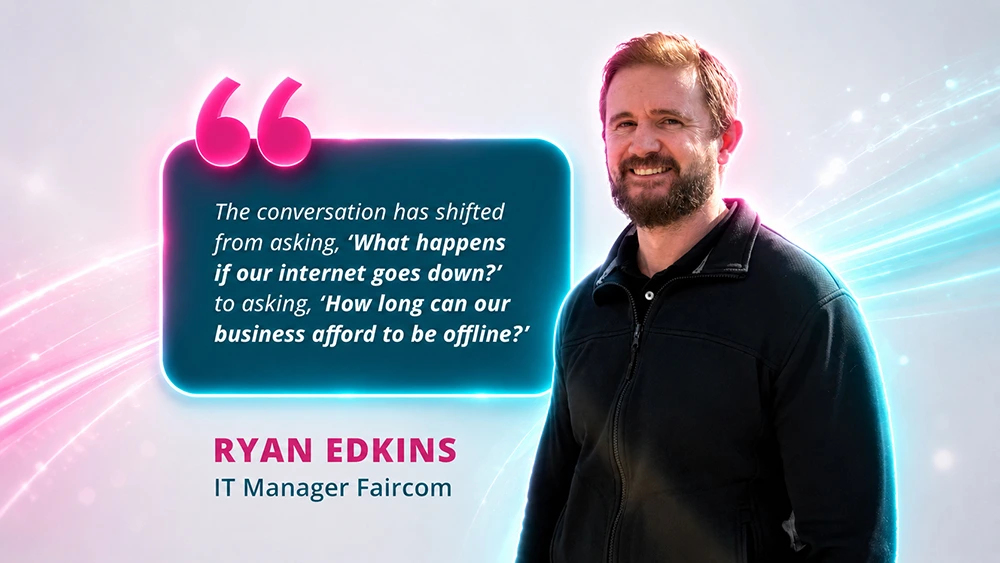
The old question used to be:
What happens if our internet goes down?
The new question – the one every business owner should be asking – is:
How long can we actually afford to be offline?
For most organisations, that answer is measured in minutes rather than hours. Once you know that, the conversation about connectivity resilience stops feeling like an IT discussion and starts feeling like exactly what it is: a core part of running a business well.
At Faircom, we assess every customer’s environment individually. We look at business criticality, application requirements, location, and existing infrastructure before recommending a solution. We do this because the best connectivity solution is the one your customers never notice. Your business simply keeps going, even when the unexpected happens.
If you’d like to talk through what resilience looks like for your business specifically, we would love the opportunity to have that conversation.